
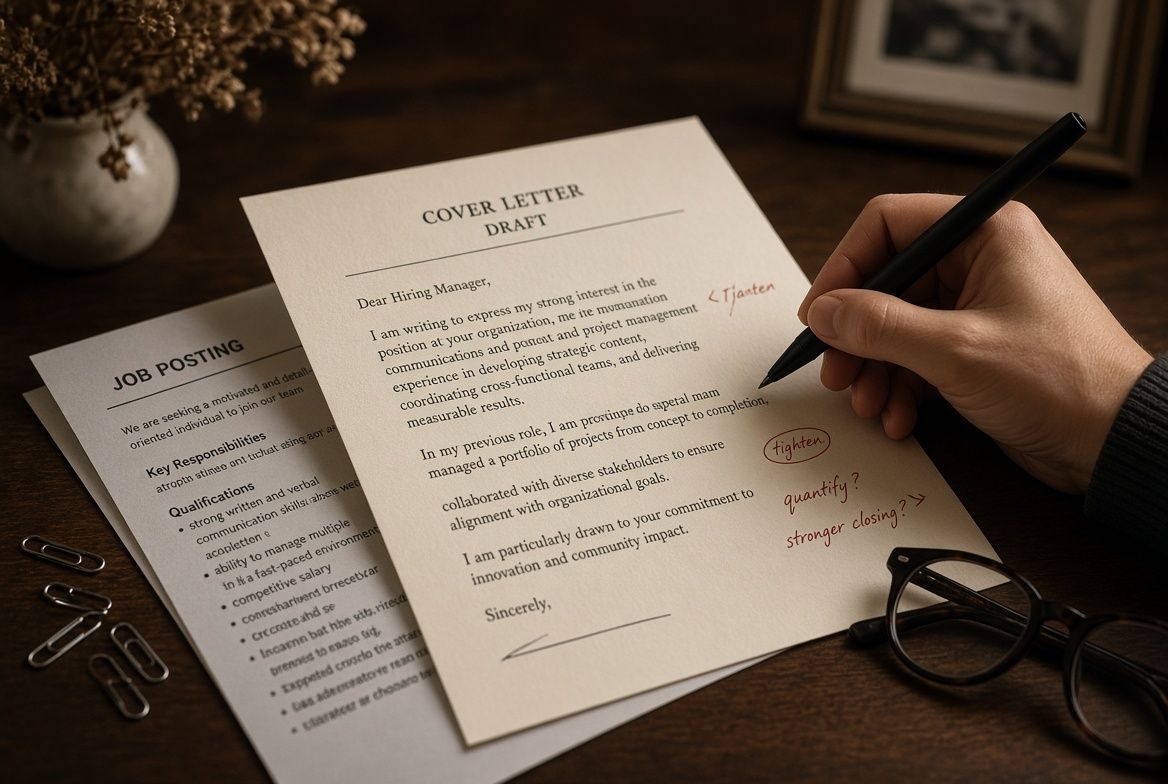
Some job seekers spend an hour on every cover letter. Others skip them entirely. Both approaches are wrong, depending on the situation. Here's when a cover letter changes your odds, when it's a waste of time, and how to write a good one fast.
The honest answer about cover letters
Most recruiters don't read cover letters. Studies and surveys over the past decade consistently show that roughly half of hiring managers consider cover letters important, while the other half either skim them or skip them entirely. A 2024 ResumeBuilder survey found that 49% of hiring managers said a cover letter influences their decision. That's basically a coin flip.
So why write one? Because you can't predict which side of the coin your recruiter lands on. And in certain situations (small companies, senior roles, career pivots), a cover letter does real work that your resume can't do alone.
The key is knowing when to invest the effort and when your time is better spent on another application entirely.
When a cover letter actually matters
The application explicitly asks for one. If a company requests a cover letter and you don't submit one, you've already demonstrated that you don't follow instructions. Some ATS platforms flag incomplete applications. Don't give them a reason to filter you out before a human even looks.
You're making a career change. Your resume says "marketing manager" and you're applying for a product management role. Without a cover letter, the recruiter sees a mismatch and moves on. With a cover letter, you explain the connection: "The customer research, competitive analysis, and cross-functional coordination I've done in marketing translate directly to the product manager role, and here's a specific example." The cover letter bridges the gap your resume creates.
You have a referral. If someone at the company told you about the role, mention them by name in the first sentence of your cover letter. Referrals significantly increase interview rates, but only if the hiring team knows you were referred. The cover letter is where that information goes.
The role is senior or client-facing. For director-level positions and above, or roles involving significant communication (PR, partnerships, account management), the cover letter doubles as a writing sample. Your ability to communicate clearly and persuasively is being evaluated, whether the job posting says so or not.
When you can skip it
The application form doesn't mention a cover letter and doesn't provide an upload field for one. This happens more often with larger companies using automated ATS workflows. If there's nowhere to put it, they don't expect it.
You're applying to a high-volume technical role (software engineering, data analysis, IT support) at a large company. These recruiters are screening on skills and experience. They're processing hundreds of applications and do not have time to read cover letters. Your resume and skills assessment carry the weight.
You can't write a specific, meaningful one in under 15 minutes. A generic cover letter ("I am excited to apply for this position at your esteemed company...") is worse than no cover letter at all. It signals that you don't know what the role involves or that you couldn't be bothered to find out. If you can't connect your experience to the specific job, your energy is better spent finding a role where the connection is obvious.
The 15-minute cover letter
You don't need four paragraphs and a formal closing. You need three focused paragraphs on a page.
Paragraph one (3-4 sentences): State the role, how you found it, and one sentence about why you're interested. If you have a referral, name them here. If you're making a pivot, acknowledge it here. Get to the point.
Paragraph two (4-6 sentences): This is the paragraph that does the work. Pick two requirements from the job posting and give a specific example for each from your experience. Not a summary of your resume. A story: what you did, what happened, what the result was. Use numbers if you have them. This paragraph should make a recruiter think: "This person has actually done this work before."
Paragraph three (2-3 sentences): Brief closing. Express genuine interest (one sentence), note your availability (one sentence), and sign off. No "I look forward to the opportunity to discuss how my unique blend of skills..." Just: "I'd welcome the chance to talk through how my experience at [Company] applies to this role. I'm available anytime this week or next."
Address it to the hiring manager by name if you can find it on LinkedIn. If not, "Dear Hiring Team" works. Skip "To Whom It May Concern" (too formal, slightly antiquated) and "Dear Sir or Madam" (gendered and dated).
What never belongs in a cover letter
Your salary expectations. Save that for the interview or the application field that specifically asks for it.
Apologies or disclaimers. "I know I don't have all the qualifications..." is a self-disqualification. If you meet 70% of the requirements, apply with confidence. If you meet less than 50%, apply somewhere else.
A recap of your resume. The recruiter already has your resume. The cover letter should add information, not repeat it. Why this company, why this role, why now? That's what belongs here.
Humor, unless you're applying to a creative agency that specifically values personality. A pun in a cover letter for a finance role is not the differentiator you think it is.
Here's your next step: look at the last five jobs you applied for. For how many of them could you have written a specific, meaningful cover letter? If fewer than three, you might be applying too broadly. If all five, start writing those cover letters. Fifteen minutes each. Set a timer.