
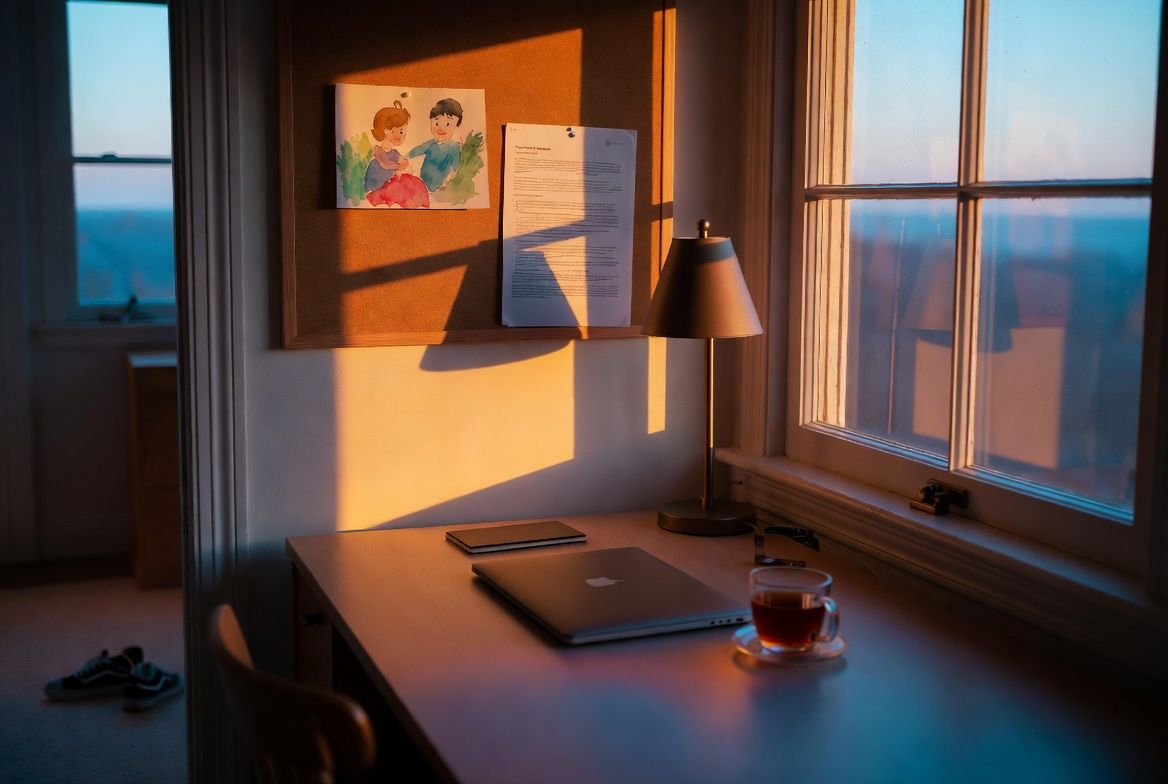
Month one of remote work, you buy the desk lamp and the ergonomic chair and you feel like you've figured it out. Month six, the chair is buried under laundry, you haven't left the house in three days, and your manager has started asking if you'd "consider coming in more often." The survival tactics that got you through the transition don't hold up over years. This is about what does.
The routines that actually last
Every remote work guide tells you to build a routine. Very few of them acknowledge that routines for parents are negotiated daily with small, unpredictable people who do not respect your calendar.
The routines that survive long-term share a specific quality: they are anchored to events, not clock times. "I start work after school drop-off" holds up better than "I start work at 8:30" because the drop-off happens regardless of whether your morning went sideways. "I close my laptop when I start dinner prep" holds up better than "I stop at 5:00" because the dinner anchor is physical and visible, while the clock is easy to ignore when you're mid-email.
After six months, most remote workers have also discovered which rituals carry actual weight versus which ones sounded good in a productivity article. The elaborate morning routine involving journaling, meditation, and a green smoothie? Gone by week three for anyone managing school lunches. The five-minute walk around the block before opening the laptop? That one sometimes sticks, because it's short enough to survive a bad morning and effective enough to notice its absence.
Build your routines around what you will do regardless, not around what you aspire to do on your best day. If you make coffee every morning, attach your work-start ritual to the coffee. If you pick up the kids at 3:15 every afternoon, that's your hard stop. Anchor to certainty.
The visibility problem nobody warns you about
Here is the part that catches remote workers at year two: you're doing great work, but nobody sees it. In an office, visibility happens passively. You walk past the VP's office. You contribute in a hallway conversation. You're physically present when an opportunity comes up. Remote work eliminates all passive visibility. Every impression you make must be deliberate.
A SHRM survey from 2024 found that managers were significantly more likely to perceive in-office employees as higher-performing than remote employees doing equivalent work. The bias isn't malicious. It's proximity-driven. People trust what they can see, and when your manager sees the person at the next desk every day and sees you only as a name on Zoom, you lose ground in ways that don't show up until promotion time.
For mothers working remotely, this visibility gap compounds with the maternal wall bias that already penalizes working parents. You are invisible twice: once because you're remote, and once because the assumption that mothers are less committed is built into how many managers evaluate performance.
Countering this requires deliberate work that feels, frankly, tedious. Send weekly updates to your manager. Not long ones. Three to five bullet points covering what you completed, what's in progress, and where you need input. Make your contributions legible in writing because they won't be visible in person. Volunteer for one high-profile cross-team project per quarter, something that puts your name in front of people outside your immediate group. Take credit for your work in meetings explicitly: "I completed the analysis on this, and here's what I found" instead of hoping someone notices.
This is not self-promotion for its own sake. This is correcting for a structural disadvantage that remote workers, and particularly remote mothers, carry by default.
When flexibility eats your personal time
The cruelest trick of long-term remote work is this: the flexibility that lets you attend a school event at 10am is the same flexibility that has you answering emails at 9pm because you "took time off" earlier. Over months and years, this pattern compresses your personal time into nothing. You're technically available to your family and technically available to work, every hour of every day, and the result is that neither gets your full attention and you never fully rest.
Research from the International Labour Organization has consistently found that remote workers log more hours than their office-based counterparts, not fewer. The flexibility is real, but so is the extension of the workday into evenings, early mornings, and weekends. For parents, this extension is especially insidious because the daytime interruptions (sick kids, school events, appointment runs) create guilt that drives evening work, which steals recovery time, which reduces next-day capacity, which creates more spillover. The cycle is self-reinforcing.
Breaking it requires one specific change: define what "done for the day" looks like, and make it a physical action. Close the laptop. Shut the office door. Put the work phone in a drawer. The action matters because your brain needs a transition signal when there is no commute to provide one. According to APA research on work-recovery processes, psychological detachment from work (mentally disengaging, not just stopping tasks) is the strongest predictor of next-day energy and engagement. You cannot psychologically detach from work that lives on the device sitting on your nightstand.
The social infrastructure you need to build yourself
Office workers absorb social connection passively. Break room conversations, lunch with colleagues, the commiseration that happens after a tough meeting. Remote workers get none of this unless they build it deliberately, and most don't, because who has time for one more calendar item?
After a year or two of remote work, isolation shows up not as dramatic loneliness but as a slow erosion of professional identity. You stop feeling like a member of a team and start feeling like a contractor who happens to attend their meetings. The Buffer State of Remote Work survey, conducted annually, has ranked loneliness and difficulty disconnecting as the top challenges of remote work every year since 2020. The results skew toward workers without children, which means the isolation data for parents (who are often too busy to even notice they're isolated until it accumulates) is probably undercounted.
You don't need to schedule virtual coffee chats with people you wouldn't talk to in person. You do need one or two professional relationships that function as genuine check-ins, people who know what your work life actually looks like and with whom you can be honest about whether things are working. If those people are inside your company, great. If they're former colleagues or friends in similar roles, that works too.
One relationship with real honesty in it is worth more than a dozen performative networking calls. Find that person. Protect that connection.
This week
Pick your end-of-day anchor action (closing the laptop, shutting a door, plugging your work phone into a charger in a room you won't enter again until morning) and do it at the same point every day for five days. Notice what changes. If you've been remote for six months or longer and you don't have a clear stop signal, you've been working a longer day than you realize, and your evenings have been paying the price.