
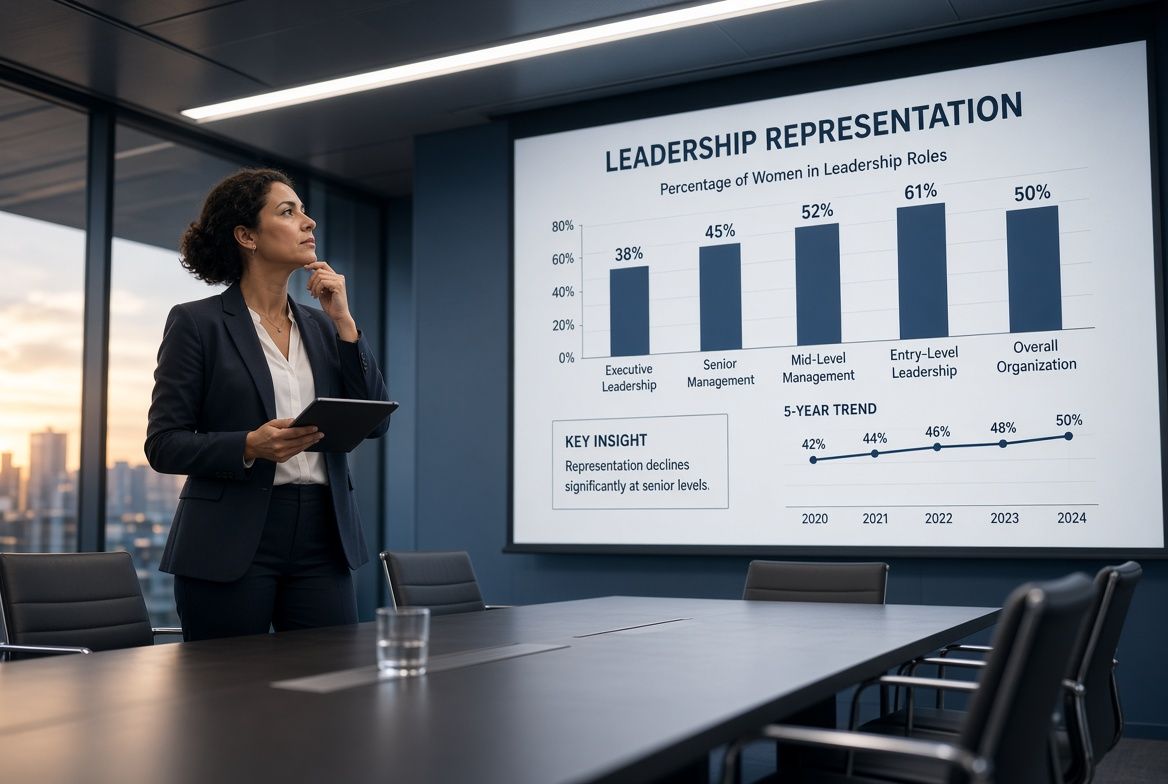
Every year a new report comes out saying women in leadership are making progress. And every year the data tells a more complicated story. The 2025 numbers are in, and while a few metrics moved in the right direction, the structural barriers are largely unchanged. Here's where things actually stand, without the motivational spin.
The C-suite number that won't move
Women hold 29% of C-suite positions in 2025. That number comes from the McKinsey and LeanIn Women in the Workplace report, and it's essentially unchanged from the prior year. At the current rate of progress, gender parity in the C-suite is decades away.
The Fortune 500 tells a similar story with slightly different framing. There are now 52 female CEOs on the list, which is a record. That sounds significant until you do the math. 52 out of 500 is 10.4%. A record-setting 10.4%.
Senior vice president and vice president levels show a similar pattern. Women make gains in increments so small they're often within the margin of error. Meanwhile, the pipeline that's supposed to feed these roles keeps leaking at every transition point.
The broken rung nobody fixed
The biggest bottleneck in women's leadership advancement isn't at the top. It's at the first promotion to manager. McKinsey calls it the "broken rung," and the 2025 data makes it painfully clear: for every 100 men promoted from individual contributor to manager, only 81 women receive the same promotion. For women of color, that number drops to 54.
This is the most important statistic in the entire gender leadership conversation, and it gets less attention than the C-suite numbers because it's less dramatic. But the math is straightforward. If fewer women make it to the first rung of management, fewer women are in the pool for director, VP, SVP, and eventually C-suite roles. Every subsequent level inherits the deficit created at level one.
The broken rung has persisted for years despite widespread awareness. Companies know about it. HR departments present slides about it. And yet the promotion rates at the entry management level remain stubbornly unequal. Knowing about a problem and fixing it are different activities, and most organizations have only done the first.
Why the rung stays broken
Promotion decisions at the first management level are often made by mid-level managers with limited training on bias. Performance evaluations at this stage tend to reward visibility and self-promotion, behaviors that research consistently shows are penalized in women but rewarded in men. A woman who advocates for herself is "aggressive." A man who does the same is "leadership material." This isn't theory. It's documented in a decade of data.
The timing compounds the problem. The first management promotion often coincides with peak caregiving years. Women in their late twenties and thirties are disproportionately likely to be managing childcare, elder care, or both. Without flexible promotion pathways, the timing alone creates a structural disadvantage that has nothing to do with capability or ambition.
The priority gap
In 2019, 65% of companies said advancing women in leadership was a priority. By 2025, that number dropped to 50%. Let that sink in. Despite years of research showing that companies with female executives are 30% more likely to outperform their peers, fewer companies are treating gender equity as a strategic objective.
Some of this reflects fatigue. Diversity initiatives launched in 2020 with high energy have settled into maintenance mode or been quietly deprioritized. Some of it reflects economic pressure: when budgets tighten, programs perceived as "nice to have" get cut first. And some of it reflects a genuine backlash in certain sectors against any targeted advancement programs.
The result is a gap between rhetoric and resource allocation. Companies still talk about women in leadership in their annual reports. They're less likely to fund the programs, adjust the promotion criteria, or change the evaluation processes that would actually move the numbers.
What the burnout data reveals
Six in ten senior-level women report experiencing frequent burnout. That rate is significantly higher than their male counterparts at the same level, and it's been climbing for three consecutive years. The cause isn't a mystery.
Women in leadership positions are more likely to be asked to serve on diversity committees, mentor junior women, and take on "office housework" (organizing events, taking notes, managing team logistics) on top of their actual roles. This additional labor is rarely acknowledged in performance reviews and almost never compensated. It's expected, unpaid, and invisible.
Combine that with the fact that women still earn approximately 84 cents per dollar compared to men, and the math starts explaining the burnout. Women in senior roles are doing more work, including work that falls outside their job descriptions, for less money, in organizations where half no longer consider their advancement a priority.
The burnout isn't a wellness problem to be solved with meditation apps and resilience workshops. It's a workload and equity problem that requires structural changes: redistributing invisible labor, paying women equitably, and actually reducing the extra responsibilities that pile onto women who reach leadership positions.
What individual women can do with this information
Data like this can feel demoralizing. That's a reasonable response. But the numbers also provide leverage, if you know how to use them.
When negotiating a promotion, cite the broken rung data. "I'm aware that women are promoted to manager at lower rates than men, and I want to make sure my candidacy is evaluated on the metrics we agreed on at the start of the year." That's not confrontational. It's informed. It signals that you know the patterns and expect a fair process.
When evaluating a company, ask direct questions about their leadership pipeline. "What percentage of your first-time manager promotions went to women last year?" If they can't answer, that tells you everything about how seriously they track it. If they can answer and the number is below 40%, you know what you're walking into.
And when the burnout creeps in, recognize it for what it is. Not a personal failing. Not a sign that you're not cut out for leadership. It's the predictable result of a system that asks more of women at every level while offering less in return. Knowing that won't fix the system, but it might stop you from blaming yourself for the system's failures.