
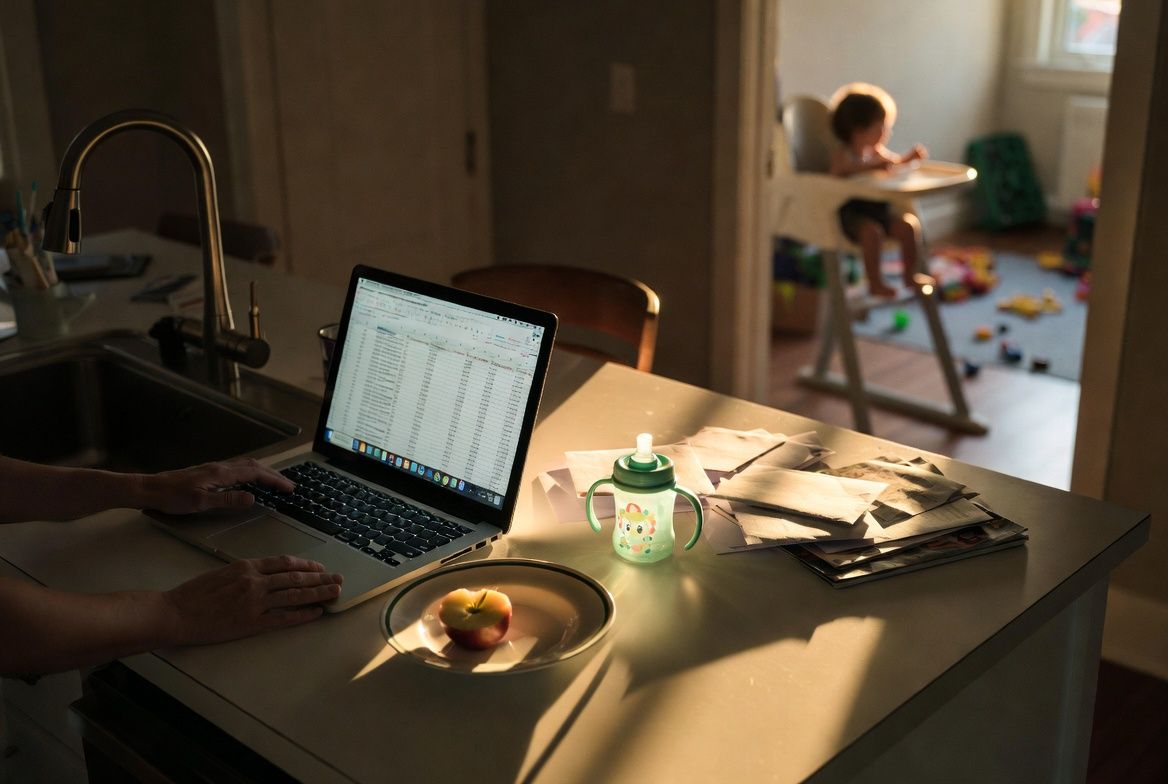
Between January and August 2025, 455,000 women left the U.S. workforce. The employment rate of mothers with children under five dropped from 69.7% to 66.9% in six months, the steepest decline in four decades. Those numbers are not abstract. They represent careers paused, income lost, and retirement savings that stopped growing.
The reversal nobody predicted this fast
During the height of workplace flexibility, women's labor force participation hit a record 78%. Remote and hybrid arrangements gave mothers the structural support that decades of "work-life balance" rhetoric never provided: the ability to be physically present for school pickup without sacrificing a full-time salary.
That progress is now unwinding. Fortune reported that return-to-office mandates are a primary driver of the exodus, with full-time in-office requirements among Fortune 500 companies jumping from 13% to 24% between late 2024 and mid-2025. Amazon, JPMorgan, and AT&T all moved to five-day office requirements. The federal government followed.
The pattern is not subtle. When flexibility contracts, mothers leave. Not because they choose to, but because the math stops working. Mothers still spend 2.1 times as much time as fathers on unpaid caregiving and household work, according to Catalyst data published in early 2026. Remove the schedule flexibility that made dual responsibilities manageable, and one income has to go. It is almost always the mother's.
The childcare equation got worse
Return-to-office mandates did not happen in isolation. Childcare prices rose at roughly twice the pace of overall inflation through 2025, driven by provider closures and staffing shortages. Federal childcare funding that kept centers open and tuition lower expired in September 2024. Many centers closed or raised rates. Some families lost access entirely.
According to KPMG research, caregiving responsibilities and childcare costs became the top reason women left the workforce voluntarily in 2025. Not dissatisfaction with their jobs. Not career pivots. The logistics of being employed while raising children became financially or practically impossible.
College-educated mothers with very young children saw their labor force participation drop to about 77% by August 2025, down from nearly 80% in 2023. Meanwhile, fathers in comparable groups edged up. The gap is widening in precisely the demographic that flexible work had nearly equalized.
Why this is a retention problem, not a women's issue
Companies that frame flexibility as an accommodation miss the business case entirely. Achievers research found that 64% of remote workers would quit or start looking if their employer eliminated flexible work. Fully remote workers show 94.2% retention rates compared to 81.6% for office-based employees. The cost of replacing a single employee runs 50% to 200% of their annual salary depending on the role.
When a company eliminates flexibility and loses experienced mothers, it is not saving on office culture. It is spending more on recruiting, onboarding, and the productivity gap that comes with turnover. An Owl Labs survey found that 40% of workers would start job hunting immediately if flexibility disappeared, with another 22% demanding a raise to compensate. The retention math favors flexibility by a wide margin.
Framing this as a gender issue lets companies off the hook. It is a workforce design problem. When 25% of all paid workdays happen remotely and a company decides to pull that back, the people who leave first are the ones with the least margin in their schedules. That is disproportionately mothers, but the organizational cost hits everyone.
This week
Check whether your company has announced or quietly implemented changes to its remote or hybrid policy in the last six months. If it has, read the updated policy carefully. Knowing what is shifting before it affects your schedule gives you time to respond strategically rather than reactively.